

If you’re shopping for acoustic panels, you’ve probably seen the term NRC rating listed in product specifications. It’s one of the most important numbers to understand when choosing sound absorbing materials, but it’s also one of the most misunderstood.
Before you invest in acoustic wall panels, ceiling baffles, or wood slat panels with felt backing, here’s what NRC really means, what it doesn’t mean, and how to use it to make a smarter buying decision.
What Is NRC Rating?
NRC stands for Noise Reduction Coefficient. It’s a standardized measurement that indicates how much sound a material absorbs.
When sound hits a hard surface (like a concrete wall), it bounces back, creating reverb. When it hits an acoustic panel, the energy is converted into a tiny amount of heat through friction within the panel’s fibers. The NRC tells you exactly how efficient that conversion is.
The scale ranges from 0.00 to 1.00:
- 0.00 = absorbs no sound (fully reflective surface like concrete)
- 0.50 = absorbs 50% of sound, reflects 50%
- 1.00 = absorbs nearly all sound
So if an acoustic panel has an NRC of 0.85, it absorbs approximately 85% of sound that hits it and reflects about 15%. Simple rule: The higher the NRC, the better the sound absorption. One of the key factors that determines an NRC (Noise Reduction Coefficient) rating is the thickness and density of the felt backing. The Panel Hub (TPH™) uses thicker and denser Acufelt™ backing to ensure more effective sound absorption and improved acoustic performance.
What NRC Rating Actually Measures
NRC measures absorption at mid-range frequencies, typically 250 Hz, 500 Hz, 1000 Hz, and 2000 Hz. These frequencies are common in:
- Human speech
- TV and music playback
- Office conversations
- General household noise
This makes NRC especially relevant for residential spaces, offices, restaurants, and home studios where speech clarity and echo control matter most.
What NRC Does Not Measure
This is where many buyers get confused.
NRC does not measure:
- Soundproofing ability
- Low-frequency bass control
- Blocking noise from neighbors
- Impact noise (like footsteps from upstairs)
If your goal is to prevent sound from entering or leaving a room, you need soundproofing materials, not just high-NRC panels.
NRC focuses purely on sound absorption inside the room.
Good NRC Ratings by Space Type
Here’s a practical guideline when shopping:
0.50 – 0.70 NRC
Light echo reduction
Good for:
- Bedrooms
- Decorative feature walls
- Small apartments
0.70 – 0.85 NRC
Moderate acoustic control
Good for:
- Living rooms
- Home offices
- Conference rooms
- Dining areas
0.85 – 1.00 NRC
High-performance sound absorption
Good for:
- Podcast rooms
- Media rooms
- Music studios
- Open-plan offices
For most residential spaces, anything above 0.70 NRC delivers noticeable improvement.
Wood Slat Panels & NRC: What to Expect
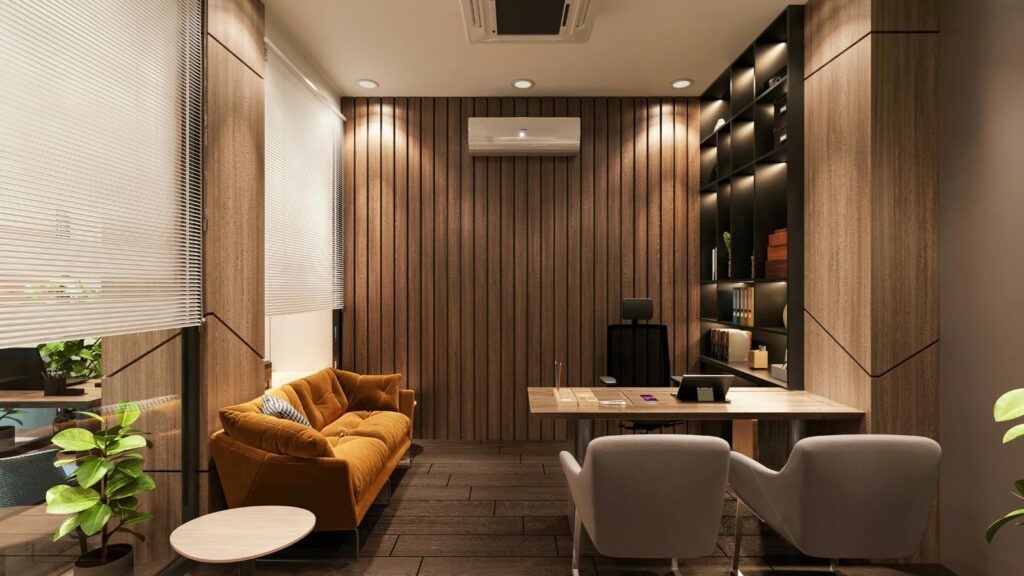
Acoustic wood slat panels combine aesthetic design with functional absorption. The wood slats reflect some sound, but the felt backing absorbs it.
Typical NRC range for quality acoustic slat panels:
- 0.60 to 0.95 (depending on installation and backing material)
They’re ideal when you want both:
- Elevated interior design
- Improved room acoustics
This makes them popular in modern homes, executive offices, and hospitality interiors.
3 Tips Before You Buy
- Thickness Trumps Surface Area: A 2-inch thick panel with an NRC of 0.85 is almost always better than a 1-inch panel with the same rating. Why? Because the thicker panel will have a much better “absorption curve,” meaning it handles lower frequencies that the NRC rating might be hiding.
- Check the Mounting Method: NRC ratings are often tested using Type A mounting (flush against the wall). However, if you leave an air gap behind your panels (offset mounting), you can actually increase the absorption of lower frequencies without buying more expensive materials.
- Aesthetics vs. Performance: You don’t have to settle for ugly foam wedges. Modern Slat Wood Panels (like those from The Panel Hub) often combine luxury wood aesthetics with high NRC felt backings. This allows you to achieve a 0.80+ NRC while maintaining a high-end interior design look.
How The Panel Hub Optimizes NRC Performance
When evaluating acoustic wood wall panels, construction details matter just as much as the stated NRC rating. The Panel Hub designs its American Acoustic Slat Wood Wall Panels with a thicker, denser acoustic felt backing compared to many standard decorative slat panels on the market. This added density increases sound energy absorption, particularly in the mid-frequency range where speech and everyday household noise occur.
The combination of precision-spaced wood slats and high-density felt backing helps enhance overall NRC performance while maintaining a luxury architectural finish. The thicker substrate not only improves acoustic control but also adds structural stability and a more substantial feel during installation. For homeowners and designers seeking both elevated aesthetics and measurable sound absorption, this layered construction approach delivers a balanced solution, visually refined on the surface, technically effective beneath it.